Brazilian rock had many phases as we've already seen in previous pages. It started circa 1957 when already established main-stream acts like Nora Ney, Agostinho dos Santos and Cauby Peixoto covered US rock hits like 'Rock around the clock' and 'See you later aligator'. By 1959, Brazilian rock had its own teen-age stars like Celly Campello, Sergio Murilo and Carlos Gonzaga who had been 'converted' from main-stream country-pop to rock.
Around 1962, Celly Campello married (just like Peggy Sue in 'Peggy Sue got married'), Ronnie Cord, a young fellow, the son of a major label A&P manager, reigned supreme as the new 'king of rock'n'roll' and there was a new crop of instrumental rock-bands like The Jet Blacks, The Jordans and The Clevers making a splash everywhere.
In 1964 there was an input of new ideas from Italy and England (mainly Liverpool)... but in August 1965 Brazilian rock entered new territory when Roberto Carlos emceed 'Jovem Guarda' a weekly rock-show on TV Record.
Early 1965 The Beatles' 'A hard day's night' premiered at Brazilian movie-theatres and kids could see there was a new kind of energy in the rock-movie-format very different from those Elvis Presley's wishy-washy flicks that had been around since 1957.
It took about 2 years - until 1967 for Brazilian rock-movies to stard showing on the local screens. That doesn't mean we didn't have rock-movies before, but let's pretend everything started in 1967. Here are some rock-movies that premiered in 1967 and 1968.
1 9 6 7
8 January 1967 - The year starts all fine with 'No reino do ié-ié-ié' (The TAMI Show) that had been shot and released in 1964 in the USA. It was only 3 years late, but what the hell... being able to see James Brown & the Flames at Cine Maracha on Rua Augusta was the best thing that could happen to me! On top of that there was a line-up of rock giants like the Supremes, Lesley Gore, the Beach Boys, Jan & Dean, the Rolling Stones and Smokey Robinson & the Miracles singing 'You really got a hold on me'...
'No reino do ié-ié-ié' (The TAMI Show) released in late 1964 in the USA; in mid-1966 in Rio and early-1967 in S.Paulo.
8 January 1967 - While one could watch 'No reino do ié-ié-ié', (At yeah-yeah-yeah's kingdom) at Cine Marachá on Rua Augusta, at Cines Olido, Maraba & Regencia one would delight in 'Na onda do ié-ié-ié' (On yeah-yeah-yeah's wave) which was only a run-of-the-mill comedy custom-made to comedians Renato Aragão & Dedé Santana with a lot of rock acts inserted to warrant the movie title. Songs were perfomed by Brazilian rock luminaries like Wanderley Cardoso, Rosemary, Os Vips, Wilson Simonal, Brazilian Bitles, Renato & seus Blue Caps, The Fevers, Clara Nunes, Ed Lincoln e seu conjunto plus popular TV MC Chacrinha.doing his usual Harpo Marx impersonation.
It so happened that when Aurélio Teixeira, its director, was to shoot a scene at MC Chacrinha's weekly gong-show on TV Excelsior, Channel 2, a future star was in the queue to have a chance to show his prowess: Paulo Sérgio entered the stage and sang 'Sentimental demais', an Altemar Dutra tune. Teixeira shot the whole thing and decided to enter the segment in the final print.
Paulo Sergio takes his chance at Chacrinha's 'Hora da buzina'.
'Hora da buzina' at TV Excelsior, Channel 2, Rio de Janeiro.
6 February 1967 - TV's comedian Costinha's 'Carnaval barra limpa' (Trendy Carnival) borrowed Jovem Guarda's lingo (barra-limpa) and had top-model Georgia Quental and Rossana Ghessa in the leading roles. But the musical numbers were done by pre-rock-era old-timers like Angela Maria, Emilinha Borba, Marlene, Clara Nunes (an exception to the rule here), Dircinha Baptista, Altemar Dutra, João Dias and Orlando Dias. TV's compere Chacrinha (real name Abelardo Barbosa) does his Harpo Marx act as usual.
Chacrinha's TV programmes came in handy to movie producers on-a-budget. They didn't have to hire expensive studio-time to shoot their flicks. They had only to ask Cachrinha to appear in a cameo role and their logistics nightmare was over. Chacrinha provided the TV studio and a live audience to boot.
26 March 1967 - a comedy called 'Rio, verão e amor' (Rio, summer and love) produced & directed by old-timer Watson Macedo (the king of 1950s Brazilian musical comedies) with heart-throb Milton Rodrigues and Elizabeth Gasper in the leading roles; Rio rock-bands Brazilian Bitles and Renato & seus Blue Caps give the rock flavour plus Bossa 3 and Zumba 5 (as Bossa-Nova combos used to be named then) play the jazzy stuff.
23rd April 1967 - Charles Chaplin's 'A countess from Hong Kong' (A condessa de Hong Kong) with Sophia Loren & Marlon Brando isn't exactly rock'n'roll but as Petula Clark's rendition of 'This is my song' became one of the best-selling discs in 1967, it sort of warrants its entry in this grouping.
25 May 1967 - a documentary shot by director Arnaldo Jabor, 'A opinião publica' (Public opinion) in which he tries to explain among other things how rock'n'roll has laid its roots so deep in the national culture and follows heart-throbs Wanderley Cardoso and Jerry Adriani in their appearances at popular TV shows like 'A discoteca do Chacrinha' where girls go insanely hysterical about their idols reminding us of Richard Lester's 1964's 'A hard day's night'.
rock-singer-cum-balladeer sings at TV's 'Discoteca do Chacrinha' in 1966.
4 June 1967 - Even though heart-throb Ricky Nelson had been around for almost 10 years, 'Amor e beijos' - 1965's 'Love and kisses' was hailed as 'muito ié-ié-ié'; is it a case of false advertising?
19 June 1967 (Monday) - Italian rock'n'roller Rita Pavone's 'Rita o mosquito' (Rita la zanzara) opens at Cine Metropole, the best venue in town. That was actually Pavone's 2nd film but 'Rita la figlia americana' (1965) in which she inter-acts with comic Totò was never released in Brazil. For a while it was thought that Italian pop-music would have a revival here but that didn't happen. From the sound-track 'Fortissimo' had a bit of air-play but not enough to get into the singles' chart even though the album sold a lot.
The lingo used by Roberto Carlos and his cronies in his 'Jovem Guarda' weekly TV show was all over the movie-ad: A bonequinha barra-limpa (trendy girl) convida o pão (hunk, hottie) o bolha (nerd, geek) a papo-firme (sharp-witted girl) e o bidú (cool dude) para deixar cair no seu 1o. filme...
4 June 1967 - 'O Incriveis nêsse mundo louco' with Mingo, Nenê, Risonho, Manito & Netinho.
Risonho (lead-guitar), Nenê (bass), Manito (saxophone), Mingo (rhythm-guitar) & Netinho (drums).

25 June 1967 (Sunday) - instrumental rock-band The Clevers had been charting since 1963, changed their name to Os Incriveis in early 1965 and started singing as well. They had toured Italy accompanying Rita Pavone in her 1964 summer tour. Their new manager Brancato Jr. took them to Europe again in 1967, filmed their mad-cap antics during the trip which became 'Os Incriveis nesse mundo louco' (The Incredibles in this mad world) probably being inspired by Stanley Kramer's 1963's 'It's a mad, mad, mad, mad world'. Watch out for a cameo appearance by Vera Lucia Couto, Miss Brazil 1964. Nissei-singer Bubby plays an important role and so does Dave Gordon a singer-actor from Guyana.
2 July 1967 - 'Os Incriveis neste mundo louco' at its 2nd week was a smash hit at Cine Olido...
In 1966, on board of Princesa Leopoldina, the first Brazilian ship to cruise back and forth to Europe, from left to right: singer Agostinho dos Santos, Brancato Junior (standing up in the middle between Agostinho & Miss Brazil) the director of the film, Vera Lucia Couto, Miss Brazil 1964, singer Alda Perdigão. Most of 'Os Incriveis nesse mundo louco' was shot during the crossing. Film director Anselmo Duarte was also on board and may have given Brancato a few tips how to go about it.
20 July 1967 - even British band Herman's Hermits had their flick released in Brazil. 'Hold on!' became 'Aguenta a mão!' which is a pretty good translation. The ad claims: Eles trazem ié-ié-ié para dar e vender... which is really corny. It looks like an old executive wrote the ad. None of the group's greatest hit is in the film.
Peter Noone (announced as Peter Blair Noone) is the star of the film; the rest of the band just plod along.

26 July 1967 - Wednesday - Maybe spurred by the success of 'Rita o mosquito' Fama Filmes did something usual: it released a black-and-white film: 'Dio come ti amo' with Italian singer Gigliola Cinquetti and US actor Mark Damon opens at Cine Rivoli, Goiás, Sammarone, Aladin, Cinemar in Santo Amaro, Amazonas & Patriarca. This tear-jerker would play in and around Sao Paulo for years to come. It became something of a phenomenon: on top of being played every single week-end on suburbia for at least 5 straight years the extended-play featuring 'Dio come ti amo' (1966) and 'Non ho l'età' (1964) went back up the charts and stayed there for almos 2 years.
'Nel cielo passano le nuvole che vanno verso il mare, sembrano fazzoletti bianchi che salutano il nostro amore... Dio come ti amo, non è possibile avere fra le braccia tanta felicità...' There goes the lyrics of such a melodic song that conquered so many million hearts all over the world...
23rd July 1967 - While the Italian & Brazilian rock movies were on... Annette Funicello was back with the 6th of a 7 beach movies this time called 'How to stuff a bikini' (Como rechear um biquini) released in the USA 2 years before (July 1965). It's hard to fathom what made luminaries like Buster Keaton, Mickey Rooney and Brian Donlevy to appear in such a second-rate movie. Probably the (lack of the) almighty dollar!
12 November 1967 - Frankie Avalon & Annette Funicello's vehicle 'Bikini Beach' (A praia dos biquinis) relesead in the USA in July 1964 was 3 years late; it had been the 3rd film in a series of 7 of the so-called beach-movies but it was released 4 months after # 6 production 'How to stuff a bikini' (made in 1965). Is it a topsy-turvy world or just plain stupidity?

15 November 1967 - Old-timer J.B.Tank of so many 1950s musical-comedies still shot films; now the 3rd movie of TV comedian Renato Aragão called 'Adorável trapalhão' in which The Brazilian Bitles who did not chart as much as they appeared on films (their 3rd so far this year after 'Na onda do ié-ié-ié' and 'Rio, verão e amor') plus Bobby di Carlo, Rosemay and The Golden Boys. Watch out for Amilton Fernandes who had played Albertinho Limonta in the Cuban soap-opera 'O direito de nascer' only 2 years before - Fernandes would be at the lobby of Cine Olido in the premiere signing autographs for the fans... plus Neyde Aparecida who had been playing young-lady roles for at least 10 years now and marvelous Lilian Fernandes one of the best Brazilian show-girls ever.


2nd December 1967 - before 1967 was out rock-balladeer Jerry Adriani had his second film released for the eager teen-agers who couldn't get enough of their favourite rock singers. 'Em busca do tesouro' (In search for a treasure) according to Herbert Richers' press-release is: Numa praia deserta, um tesouro valioso cai em mãos dos
Pequenos Cantores da Guanabara, que por sua vez, o entregam a Jerry Adriani e
Neyde Aparecida. E no encalço, um mal-encarado chamado Rock Trombada (Luis
Delfino), um diretor de TV (Amandio), sua perigosa amante (Diana Azambuja), um
cientista (Fernando Torres) e vários malandros (Milton Gonçalves, Fabio Sabag,
Daniel Serra). Daí uma 'deliciosa e divertida confusão' (sic).

24 December 1967 - Jerry Adriani's first flick called 'A Grande Parada' (The great parade) was the title of a TV Tupi weekly-show MCed by himself and Neyde Aparecida who doubles-up as his love interest in the film. I could not find when it was first released as it looks this was the 2nd time it was shown in Sao Paulo. Duo Leno & Lilian sing 'Eu não sabia que você existia'.
Could you actually call Jerry Adriani a 'rock singer'? Judging from this tuxedo and body-language it is as far from rock'n'roll as an Italian opera...
24 December 1967 - Italians also had their 'beach movies'. Actually Italians had twice as many beach-movies than Americans. Sometimes I think they shot those movies just to insert their summer hits in the sound-tracks. You would be watching these movies and listen to Rita Pavone, Edoardo Vianello, Bobby Solo, Adriano Celentano, you name-it in the background. 'Brotos ao sol' (Diciottenni al sole) was actually 5 years late for it was released in 1962. It had various rock hits on the sound track like Gianni Morandi's 'Go kart twist'.
1 9 6 8
8 January 1968 - the fatal year of 1968 starts all fine with 'Non stuzzicate la zanzara' (Não brinque com o mosquito) Do not tease the mosquito - Ria Pavone rocks the screen again now with a little help from Giulietta Masina plus Giancarlo Giannini & Peppino de Filippo. Even though the plot is inferior to 'Rita o mosquito' the musical number are more sophisticated.
15 February 1968 - 'Ritmo explosivo' (The big T.N.T. Show) the sequel to 'The TAMI Show' (No reino do ié-ié-ié) both produced by Henry G. Sperstein, was shot before a live audience at the Moulin Rouge Club in Los Angeles, on 29 November 1965; released in Brazil 2 years later - the same time it took 'TAMI Show' to be shown here.
It was shot on videotape and transferred to 35 mm film. David McCallum emcees Ray Charles (What'd say?), Petula Clark (Downtown), the Lovin' Spoonful (Do you believe in magic? plus 'You didn't have to be so nice), Bo Diddley, Joan Baez singing 'You've lost that lovin' feeling' accompanied by Phil Spector on the piano, the Ronettes (Be my baby), the Byrds ('Turn turn turn' plus 'Mr. Tambourine Man'), Donovan and Ike & Tina Turner.
For Brazilian fans who were used to watching 'Jovem Guarda' on TV on Sunday afternoon 'Ritmo explosivo' on Cine Miami was a shot in the arm. You didn't want to leave the cinema.
11 March 1968 - Maurice Capovilla's 'Bebel, a garota propaganga' (Bebel, the poster-girl) based on the novel 'Bebel que a cidade comeu' (Bebel who was eaten by the city) by Ignacio de Loyola Brandão.
rock singer Marcos Roberto & Rossana Ghessa; Mauricio do Vale does his best to be non-chalant.
Geraldo Del Rey plays a non-conformist dude; Sao Paulo skyline in the background


The Bells: Carlos (g), Ary (drums), Tergole (sax), Nilo (g), ? (sax) & Di Souza (bass); Tergole plays away.
Rossana's London-swings in Sao Paulo; Wilson Simonal, Clara Nunes & Dino & Dino on the wall denotes the flick had some EMI-Odeon backing.
Rossana Ghessa in Maurice Capovilla's 'Bebel, garota propaganda'
DeKalafe was the coolest possible act in late 1967 and she shows why.

24 March 1968 - Old-timer Anselmo Duarte who played romantic leads in the 1940s and 1950s is Wanderlea's sugar-daddy in 'Juventude e ternura' ; Cyll Farney another 1950s heart-throb must play some long-forgotten uncle; Amilton Fernandes plays a lawyer this time; Wanderlea's romantic interest is not sugar-daddy but Enio Gonçalves someone closer to her age; rock singer and instrumentalist Bobby di Carlo plays an adaptation of Giselle Galos's 'Le lac de Come' (Nocturne Op.24) on a mandolin. Wanderlea sings 'Ternura' (Somehow it got to be tomorrow today) her most popular ballad plus 'Foi assim' (another tear jerker) and 'Prova de fogo', a rocker.
Wanderlea and Enio Gonçalves fall in love in 'Juventude e ternura' (Youth and tenderness).
Intervalo 1967.


5 April 1968 - Roberto Carlos's first film 'Roberto Carlos em ritmo de aventura' was eagerly awaited by his fans. Most of the film's songs were released in December 1967 and had been playing on the radio ever since: 'Quando', 'Eu sou terrivel' and 'Como é grande o meu amor por você'.
CBS's 'Roberto Carlos em ritmo de aventura'
RCA Italiana's 'Little Rita nel West'


15 July 1968 - Just when you thought it was safe to go the movies without having to be pestered by Django, Ringo, Sartana, Joe Dynamite etc. here comes 'Little Rita nel West' (Rita no West)... Rita Pavone's 3rd movie in 13 months. It coincided with the spaghetti-westerns overkill. There were dozens of Italian westerns being shown at cinemas all around Brazil. 'Vou... mato e volto' (Vado, l'ammazzo e torno) that some Brazilians tongue-in-cheek called 'Vou no mato e volto' was one of the most popular so far.
30 September 1968 - One of the most popular rock-movies 'To sir with love' (Ao mestre com carinho' featured the song of same title with British rock-singer Lulu which went to #1 here and everywhere else.
13 October 1968 - Even though Italian music was on the wane in Brazil, Italian movies still reigned supreme, especially spaghetti-westerns, comedies and now musical dramas. Italian rock singer-cum-balladeer Gianni Morandi had a big hit with 'In ginocchio da te' in 1964 which later became a movie but was never released here. Morandi's follow-up hit 'Non son degno di te' (Não mereço você or 'I'm not worth of you') was shot in 1965 and released here 3 years later when Fama Filmes realized after the receipts gained from 'Dio come ti amo' that there was a market for Italian tear-jerkers among Brazilian youth. Young Brazilians apparently didn't rock so much as they cried hidden in the darkness of a movie-theatre. Actress Laura Efrikian was Gianni Morandi's wife when they shot both films.

The ad says: 'A mesma doçura! O mesmo encanto de 'Dio come ti amo'; which translates as: The same sweetness! The same loveliness of 'Dio come ti amo'... What to expect from a 'rock' movie which is called 'I'm not worth of you'?
15 December 1968 - British pop-star Tommy Steele stars in 'Half a sixpence' (A moedinha do amor).
29 December 1968 - and to finally close a tragic year for Democracy in Brazil - for on 13 December 1968 the Military Dictatorship that had abolished free-speech in the country issued the infamous AI-5 (Institutional Act no. 5) which plunged the country in complete darkness and backwardness. Well, to close 1968 which saw so many spaghetti-westerns how about 'Buckaroo' ('A Whinchester que não perdoa' or 'The Winchester that never forgives')! You may as well ask: 'But where's the rock'n'roll connection there?' Its star is Dean Reed, an American rock singer who defected to the so-called Iron Curtain (Communist countries aligned to the USSR) and became a rock'n'roll idol in East Germany aka Communist Germany and most Eastern Europe countries.
Dean Reed in his rock'n'roll days...


Dean Reed visits Chile and other South America countries in 1962.
1 9 6 9
12 January 1969 - rock-singer cum baladeer Rosemary teams up with samba-singer Jair Rodrigues in 'Jovens p'ra frente' (Advanced youth) shot in 1968. Old timers Oscarito & Heloisa Helena play the adults plus Clara Nunes, Beat-Boys, Jose Ricardo and others.
16 March 1969 - baladeer Wanderley Cardoso is back on the silver screen again with 'Pobre principe encantado' (Poor charming prince). This time instead of having the company of Renato Aragão & Dede Santana as in 1967's 'Na onda o ié ié ié' he has old timer's Chacrinha. I wonder whether it was any better!
16 March 1969 - Could you possibly consider Agnaldo Rayol as 'rock'... maybe stretching the term a little... well, Agnaldo was a middle-of-the-rock tenor who sometimes recorded a ballad that could eventually 'pass' as a rock-ballad. As of 1967 Agnaldo's TV show on TV Record was actually the most popular among them all beating Roberto Carlos's 'Jovem Guarda' and Elis Regina's 'O fino da bossa'. I have never watched 'Perigo à vista' (Danger on sight) so I could not give my opinion whether it's any good.


16 March 1969 - If Agnaldo Rayol has passed the litmus test and entered rock'n'roll glory, deceased torch-songstress Dolores Duran (she died in her sleep on 24 October 1959) could not be denied such a glittering prize. After all, Miss Duran recorded a few rock numbers in her days such as 'Love me forever'. The movie 'A noite do meu bem' took its title from Dolores Duran's best known song, actually the last she recorded before she died. Is this a rock-movie? Probably not, but Agnaldo's is not either...

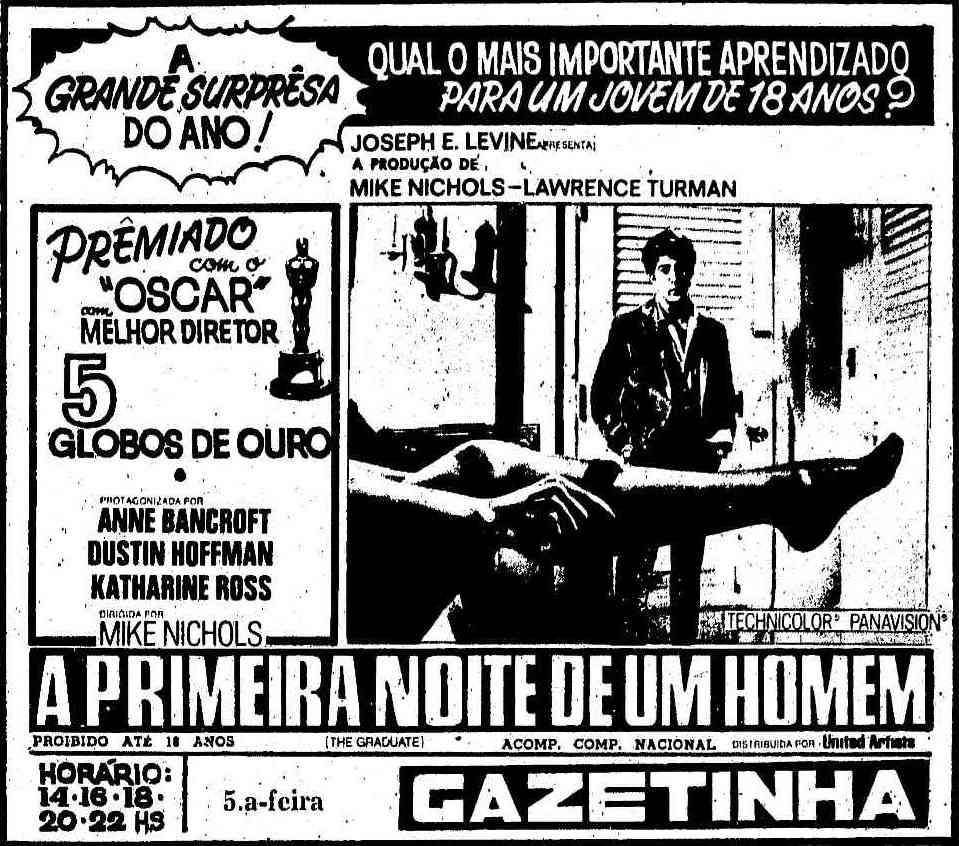
20 March 1969 - Mike Nichols' 'The graduate' (A primeira noite de um homem) introduces the beautiful music of Simon & Garfunkel and a promissing new actor: Dustin Hoffman.
13 July 1969 - Released in the United Kingdom on 17 July 1968, The Beatles' 'Yellow submarine' (Submarino amarelo) opens at Cine Olido and Cine Iguatemi a year later.
1 9 7 0
2nd March 1970 - Dennis Hopper's 'Easy rider' here dubbed 'Sem destino' (Without destination) was a road-movie and a rock-movie to boot...
19 April 1970 - John Schlesingers 'Midnight cowboy' dubbed as 'Perdidos na noite' (Lost in the night) introduced Nilsson's 'Everybody's talkin' one of the most haunting songs ever written... that shot up the charts here and around the world.
26 April 1970 - new rock prince Antonio Marcos is hailed as the great white hope and sings 'Menina de trança' (Girl with pig-tails)... cartoonist Ziraldo supplied the art work and Martinho da Vila does a small role... Here's OESP's movie review:
5 July 1970 - Roberto Carlos' second movie was a blatant rip-off of The Beatles' second movie 'Help'. The title says it all: 'Roberto Carlos e o diamante cor-de-rosa' (RC and the pink diamond). Maybe a reference to Blake Edwards' 1964's 'Pink panther'? What a drag!
12 July 1970 - The Monkees were the first band on TV but the last to arrive at the movies with 'Head' or 'Os Monkees estão soltos' (Monkees are loose). It had Frank Zappa & The Mothers of Invention in the cast plus prize-fighter Sonny Liston, Hollywood old-timer Victor Mature and Annette Funicello. Screen-play by Bob Rafelson & actor Jack Nicholson. They tried to make the Monkees hipper than they actually were and the film was a commercial flop. Besides it was almost 2 years late having premiered in the USA on 6 November 1968.
23rd July 1970 - The Beatles' farewell concert was somewhat sadly pathetic... it premiered in the USA less than 2 months before: 13 May 1970... that was almost simultaneously. Films usually took between one and two years to reach Brazil then.