Sunday, 7 September 2014

1959 - 1960 - 1961 Rock scrap-book

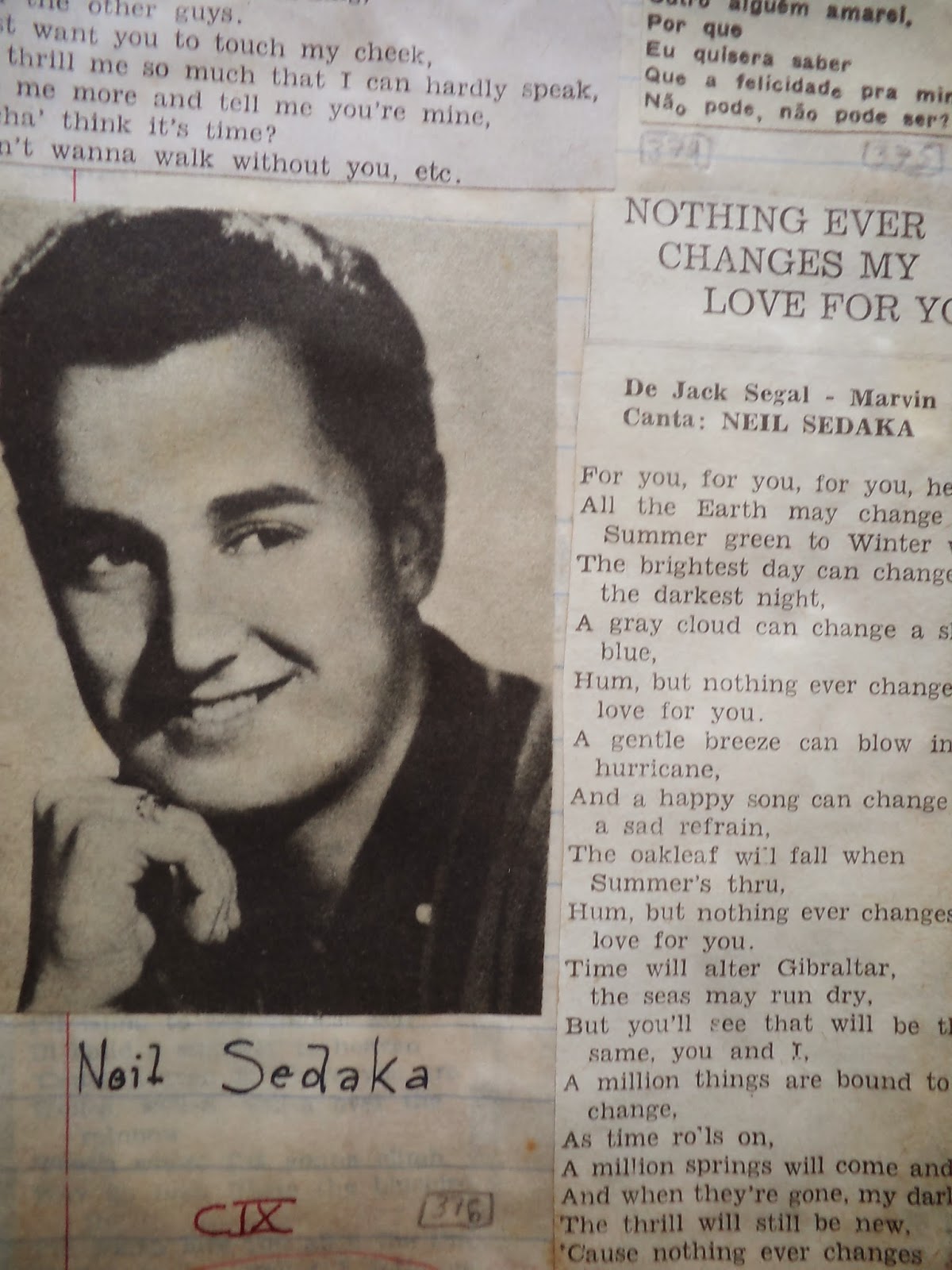
One can almost follow Brazilian Rock History going through this 1961 scrap book that belonged to Silvia Paula Jentsch, a girl from São Paulo who was born in 1942 and was obviously a rock fan. 

Neil Sedaka was big in Brazil since late 1959 - Brenda Lee visted Brazil in 1959
Elvis was big but not the greatest - Ronnie Cord was a Brazilian young man trying to pass off as a Gringo 
Celly Campello was undoubtedly the Queen of Rock - Bobby de Carlo hit with 'Eliana' in 1960
'Lacinhos cor-de-rosa' (Pink shoe laces) - 'Pobre de mim' (Poor little fool)
Celly Campello's 'Estupido cupido' - Carlos Gonzaga's 'Foi teu beijo' (Something has changed)
Celly's 'Mal-me-quer' (Doris Day's 'Don't eat the daisies')
Celly's 'Broto certinho'  - Sergio Murilo's biggest hit: 'Marcianita'
Ronnie Cord's 2nd hit 'Look for a star'
Neil Sedaka, Brenda Lee, Connie Francis & Sergio Murilo
The Platters were the most popular do-wop group in Brazil - Brenda Lee's 'That's all you gotta do'
Sedaka, Anka, Presley & Brenda Lee were the most popular US rock acts in Brazil 
Demetrius was local royalty - Pat Boone was quite popular among Brazilians too.
Frankie Lymon & Frankie Avalon visited Brazil in 1961 - Elvis never crossed south of Rio Grande except in 1963, when he filmed 'Fun in Acapulco' in that Mexican resort. 
Paul Anka & Neil Sedaka had rival fan clubs. One was either for Paul or Neil. They didn't mix.
Elvis had a different following: young people had the chance to see him in the movies
Hamilton Di Giorgio recorded in English at first, then switched to Portuguese later on
Cliff Richard had an attitude, but not hits in Brazil. Chubby Checker was huge in 1962.
Bobby Vee had a nice face, but no hits. Celly Campello meets Neil Sedaka

Caterina Valente was pre-rock but she knew how to rock it - Carlos Gonzaga was undeclared King
Celly Campello & Sergio Murilo were royalties in Brazil up to 1962.

Saturday, 6 September 2014

São Paulo rock x Rio rock / Rock'n'roll DJs

Since the inception of commercial radio in Brazil circa 1930, Rio de Janeiro and São Paulo have built different centres of musical and cultural activities. Rio de Janeiro had a bigger slice of that activity because most of the foreign recording companies as Victor, EMI and Columbia were based in the Federal District - Brazil's capital. Rio's Radio Mayrink Veiga was the most popular radio station in the nation until the federal government created Radio Nacional in 1936 and took its place at the top after a couple of years.

Radio Record was São Paulo's most popular radio station in the 1930s and by 1960 São Paulo was as powerful as Rio in the cultural arena having not only radio stations but 3 different TV broadcasters.

By 1955, rock'n'roll was the new rage in the USA but it took some time to take its roots here. By 1960 it was clear to see that rock had two different sources. São Paulo was problably at the forefront with Celly Campello & her brother at the top of the charts.

Both cities had rock'n'roll shows on radio and TV. By 1963, D.J. Antonio Aguillar was São Paulo's hottest rock MC having radio shows at Radio Nacional Paulista and TV Paulista.

In Rio, Celia Vilela had her own TV rock show on TV Continental and Jair de Taumaturgo had a high-rating show on Radio Mayrink Veiga called 'Hoje é dia de rock' (Today's is rock's day).
Antonio Aguillar MCs his TV rock show in 1963. The Clevers' s drummer Netinho on the left.
Cidinha Santos (Ilze Aparecida) sings a twist at Antonio Aguillar's TV show in 1963 while dancers from night-club Lancaster (Chupeta & Bolão are identified here) dance their cares away.
Rossini Pinto, seen here with former President Janio Quadros (1961) was a singer-song-writer who had his base in Rio de Janeiro working mainly for CBS Records.

Carlos Alberto Lopes at his workshop talks to YouTube in 2018.
Carlos Alberto Sossego dies 

Carlos Alberto Lopes aka Sossego ele deixou uma marca indiscutível no segmento de amplificadores feitos no Brasil.

Em entrevista com a Custom Shop Brasil, Carlos Alberto “Sossego” explicou que seu sobrenome na verdade era Lopes, mas todo mundo conhecia ele como “Sossego” e desse jeito ele será lembrado para sempre. 

Carlos Alberto “Sossego” faleceu na sexta-feira, 28 Fevereiro 2020, em São Paulo.

Ele foi um dos primeiros DJs no Brasil, começando no rádio em 1957 tocando sucessos do Cash Box quando ainda ninguém conhecia e trouxe os primeiros amplificadores Marshall ao país em 1968.

Aos 15 anos ele começou a aprender sobre eletrônica, depois trabalhou numa loja da Santa Efigênia montando transformadores e amplificadores, até que um dia um amigo pediu para consertar o amplificador de guitarra que tinha quebrado, era um modelo Fender de 1959. Carlos pediu para um amigo professor de inglês escrever uma carta para a Fender pedindo todos os esquemas desse modelo. Um mês depois recebeu pelo correio um envelope grosso da Fender contendo os esquemas de todos os amplificadores que a empresa fazia e assim começou sua paixão.

Trabalhou na Giannini, assistindo no desenvolvimento das guitarras Supersonic e dos amplificadores Tremendão. Mais recentemente se dedicou a construir amplificadores na sua própria oficina. Sempre será lembrado na indústria do áudio nacional. Descanse em paz!

Friday, 5 September 2014

DEMETRIUS

Demetrius's first single 'Hold me tight' b/w 'Young and in love' was recorded at Miguel Vaccaro Netto's Young Records and released on 7 July 1960. He was a natural rocker following the Elvis school.

Demétrio Zara Netto was born on 28 March 1942, in Jacarépaguá, Rio de Janeiro-DF. Apparently his family moved to São Paulo when he was still a child.

Demetrius was good looking, had the right attitude and knew how to behave on the stage. He started his singing career in English but in 1961, Diogo Mulero, A&R man at Continental Discos knew better and convinced Demetrius to sing 'Corina, Corina' in Portuguese.

'Corina, Corina' was a big hit, something Young Records could have never matched. Demetrius had finally arrived.
 rockers Tony Campello & Demetrius.
 Demetrius had the right look and attitude.
 Demetrius was a teen-age heart-throb in 1961.

17.902 - June 1961
'Corina, Corina' (Corrina, Corrina) v.: Demetrius / Let's think about loving (B.Bryant)

18.028 - November 1961
'Cuide certinho do meu bem' (Take good care of my baby) / 'Alfabeto de Natal' (Christmas alphabet)
78-020 - 'Rock do Sacy' (Baby Santiado-Tony Chaves) / Broto levado (Demetrius)
78-024 - 'Cinderella' (P.Anka) / In the fool's hall of fame (Paul Anka)
78-068 - 'Namoradeira' (Runaround Sue) / ...                        May 1962
78-313 - 'O ritmo da chuva' (Rhythm of the rain) / 'Despenteada' (Despeinada) - Jan. 1964
78-020 'Rock do Sacy' b/w 'Broto levado'.
78-024 'Cinderella' b/w 'In the fool's hall of fame'.
78-313 'O ritmo da chuva' (Rhythm of the rain) b/w 'Despenteada' (Despeinada).

'Demétrius canta com amor e mocidade' album was released in December 1961.

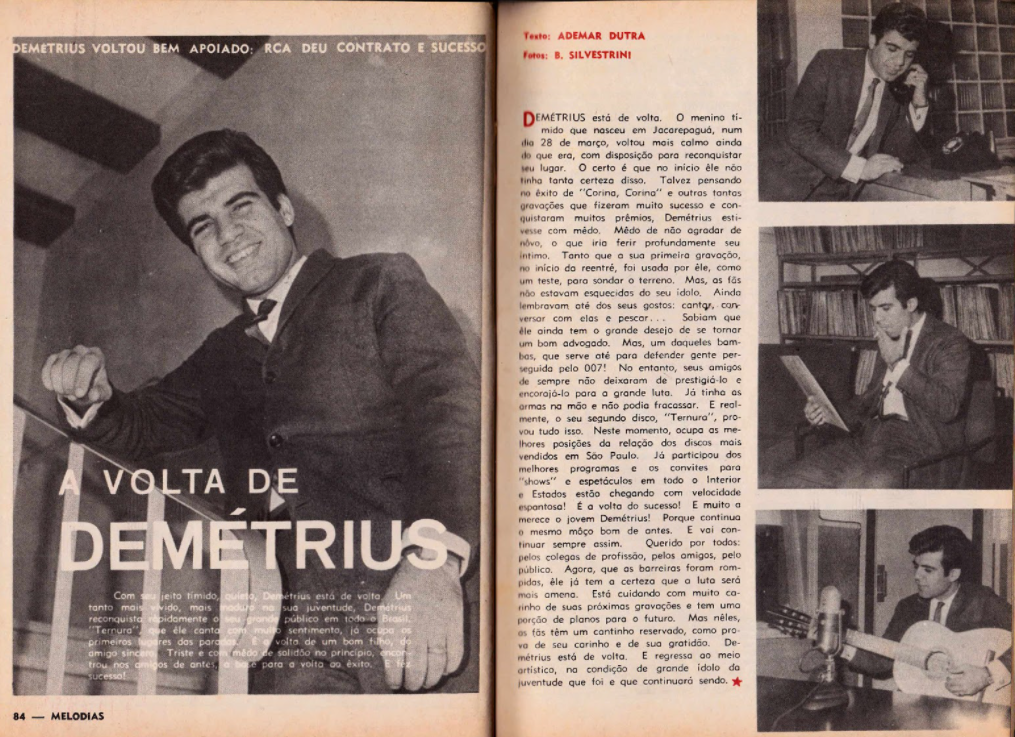
Demétrius is back to the limelight in late 1965, in the wave of the hullaballoo created by Roberto Carlos and 'Jovem Guarda' his TV rock-show started on 22nd August 1965. Demétrius had been #1 in early 1964 with 'Ritmo da chuva' (a cover of The Cascades' 'Rhythm of the rain') but could not have a follow-up so he sort of slowed down and went fishing more often which is what he really enjoy in life. 

When he saw what 'Jovem Guarda' was accomplishing he felt like 'coming back'; RCA Victor which wanted badly to compete with CBS in the field of Brazilian rock, approched him and he signed in the dotted line. Soon he recorded 'Ternura', translated to Portuguese by Rossini Pinto, from 'Somehow it got to be tomorrow (today)' for his new label. 'Ternura' played quite well on the radio stations even though there was heavy competition from Wanderléa who had recorded it first. 'Melodias' # 102 of December 1965.
Demetrius with Nancy dos Santos in 2013. Nancy was Agostinho dos Santos' daughter who had 'A Ferradura', a busy bar in São Bernardo do Campo-SP which she turned into her Father's shrine. Demetrius used to hang out there on Sundays afternoon. 
Nancy dos Santos, Demetrius & a patron of 'A Ferradura', in 2013.

N.B.: Demétrius, Demétrio Zahra Netto was born on 28 March 1942, in Rio de Janeiro-DF (Jacarépaguá) and died on 11 March 2019, in São Paulo-SP due to a cardiac arrest. He was 76 years old.

Nancy dos Santos died on 7 July 2020.