Saturday, 18 August 2018

1956 - 1963 CINEMA ROCK

8 January 1956 - Richard Brook's 'Blackboard jungle' (Sementes de violência) with Glenn Ford had 'Rock around the clock' with Bill Haley and His Comets in the sound-track and is considered the very first movie in which rock'n'roll is mentioned.
12 June 1956 - 'Correio da Manhã' reviews 'Blackboard jungle' (Sementes de violência) released in Rio 5 months after São Paulo. The reviewer begins well, but soon loses himself to mediocrity, plain ignorance and chauvinism:

'Os que vêem 'licenciosidade' e 'falsidade' nesse filme, demonstram, de acordo com a critica lúcida dos Estados Unidos, além de miopia... É através de obras tão 'controvertidas' como 'The wild one' (O selvagem), 'From here to eternity' (A um passo da eternidade) e 'The Cairns mutiny' (A nave da revolta), que, sobrepondo-se aos ataques de censores intelectualmente estreitos, o cinema americano reafirma ser o mais democrático de todos os cinemas - ao mesmo tempo em que confunde os seus detratores crônicos, orientados, no mais das vezes, por Moscou.' 

It is a temerity to say that Hollywood was the 'most democratic cinema in the world' when everyone knew most of the European cinema was decades ahead of the Yankees. Besides, the USA were barely out of the McCarthism witch-hunt, one of the most anti-democratic crusades ever perpetrated in the world.
19 December 1956 - eagerly waited 'Rock around the clock' (Ao balanço das horas) premieres at Cine Ipiranga, Trianon, Paulista plus 9 other play-houses in Sao Paulo. Soon, newspapers would report about vandalism happening at Cine Paulista on Rua Augusta.
21st December 1956 - Rio's 'Correio da Manhã' reports about Cine Paulista's being vandalized by middle class youth during the projection of 'Rock around the clock'. Note that the word 'rock'n'roll' is treated as a feminine noun: 'a rock'n'roll'... eventually it would become a masculine noun.
30 December 1956 -
15 January 1957 - Three weeks later the same kind of vandalism happens in Rio de Janeiro too.
10 March 1957 - Right on 'Rock around the clock's heels came 'Don't knock the rock', another exploitative film to cash in on the rock wave.
13 October 1957 - 'soft' rock'n'roll balladeer Pat Boone stars in 'Bernardine' (O sonho que eu vivi) released in the USA only on 24 July 1957; old timer Janet Gaynor plays somebody's mother.
4 May 1958 - Elvis Presley's 2nd flick for Paramount Pictures, 'Loving you' (A mulher que eu amo). 
11 May 1958 - Paramount's Elvis Presley's 2nd flick 'Loving you'.
16 July 1958 - Tommy Sands became an overnight sensation and instant teen-idol when he appeared on Kraft Television Theater in January 1957 as 'The singin' idol' where he played the part of a singer was was very similar to Elvis Presley, with guitar, pompadour hair, and excitable teenage fans. The song from the show, 'Teen-age crush' reached #2 on 23rd February 1957, at the Billboard charts for 2 weeks.

'Sing, boy, sing' was shot in record time by Fox and released in the USA in February 1958, to positive reviews, but it turned out to be a financial failure.
12 October 1958 - a 1957 Hollywood production 'Jamboree' called here mistakenly as 'O festival do jazz' was one of the first rock'n'roll exploit-movies. Brazilian singer Cauby Peixoto who was living in the USA in 1957, appears in the credits as Ron Cobby, plays a rock D.J. and sings something about a toreador...
2nd November 1958 - Elvis Presley's most successful rock song becomes 'Prisioneiro do rock and roll' - 'Jailhouse rock'.
25 January 1960 - Mazzaropi's rural hero 'Jeca Tatú' may be the farthest thing possible from rock'n'roll but it was the flick that introduced Brazilian rock sensations Tony & Celly Campello to a larger audience.
24 November 1960 - 'The beat generation' (A noite dos malditos) starring Steve Cochran, Mamie Van Doren who made rock'n'roll movies a career in itself, Ray Anthony (Van Doren's husband then) and Louis Armstrong who could be anything he wanted. 
16 July 1961 - This Elvis Presley vehicle could hardly be considered as a 'rock movie'. 'Flaming star' (Estrêla de fôgo) is actually a 'western' where he plays a half-breed named Pacer Burton. This was Presley's 6th flick. He started in 1956 with 'Love me tender'; in 1957 with 'Loving you' and 'Jailhouse Rock'; in 1958 with 'King Creole'; in 1959 he served the US Army in Germany; when he came back to the States in 1960, he shot 'G.I. Blues' and this western.
7 September 1961 - One could hardly call 'Where the boys are' - quaintly translated into Portuguese as 'It takes two to fall in love' (Bastam dois para amar) - as a 'rock movie' except for the presence of Connie Francis as an actress and singer and Neil Sedaka's having written the opening title. George Hamilton and Yvette Mimieux were the first stars to confirm their presence. Paula Prentiss was cast despite never having made a movie before. Connie Francis also made her movie debut.
'Where the boys are' is less rock than cool modern jazz - or West Coast jazz - popularized by such acts as Dave Brubeck, Gerry Mulligan and Chico Hamilton, then in the vanguard of the college music market, features in a number of scenes.

MGM bolstered the film's success potential by giving a large role to Connie Francis who solicited the services of Neil Sedaka & Howard Greenfield, to write original material for her. Sedaka & Greenfield wrote 2 potential title songs for the film, but producer Joe Pasternak passed over them in favour of a lush 1950s style movie-theme. Francis recorded 'Where the boys are' on 18 October 1960, in a NYC session with Stan Applebaum arranging and conducting.
22nd October 1961 - This ain't exactly a 'rock' movie but for the appearance of heart-throb Paul Anka opening the credits singing and playig his 1959 hit 'Adam and Eve'. Mamie Van Doren always had a foot in the music business being the wife of horn-player Ray Anthony besides having appeared in seminal 'rock movies' like MGM's 'High School confidential' (1958) and 'Girls town' in 1959 where she appeared in the nude. Tuesday Weld always played a 'rebel kid'... and Marty Milner would be at Route 66.
4 January 1962 - 'Dançando o twist' - 'Rock around the twist' - was a new dance-craze which was actually an off-shoot of rock'n'roll & rhythm'n'blues.
14 January 1962 - A week later Paramount announces 'Vamos ao twist' (Hey, let's twist) introduces Joey Dee & the Starliters plus Teddy Randazzo and Jo Ann Campbell.  
29 September 1962 - At the height of the twist craze in Brazil 'Don't knock the twist' (Ao ritmo do twist) with Chubby Checker starts playing in Rio de Janeiro.
30 September 1962 - 'Ao ritmo do twist' was 'Don't knock the twist' released in the USA on 13 April 1962. It features Dee Dee Sharp singing 'Mashed potato time' which was her greatest hit ever having got to #2 on 2nd May 1962 while the film was showing in the US.

Saturday, 23 June 2018

Neil Sedaka & Celia Vilela in 1963

Ever since Neil Sedaka was in Brazil for the very first time, in November 1959, even before he had his first top-10 hit in the USA ('Oh! Carol' would hit #9 at Billboard's weekly survey on 7 December 1959) he and Celia Vilela developed a strong friendship that some would say amounted to a full-on romance. 

The fact is Miss Vilela visited the USA soon after (January 1960) and was a guest at Neil Sedaka's home in Brooklyn, N.Y. where she had the chance to meet the whole Sedaka family: Mum & Dad plus sister Ron who would show a bit of New York City to the Brazilian starlet. 

By the end of 1960, Sedaka had established himself as a 'teen-singer' with 'Stairway to heaven' at #9 on 18 April 1960 and 'Calendar girl' at #4 on 31st December 1960.

Sedaka was back in Brazil in March 1961. He visited a few radio stations in Rio de Janeiro and had a lot of photo opportunities with Celia Vilela who had a radio show at Radio Globo by then. 

1962 would be Sedaka's best year when he finally reached #1 at the charts with 'Breaking up is hard to do' on 7 July 1962. While Sedaka reached the top of the charts in the USA he was actually in Brazil doing his 2nd singing tour. He performed at Teatro Record on 13, 14 & 15 July 1962

Six months later, January 1963, Sedaka is back in Rio de Janeiro where he would take part in 'Instant love' (Pão de Açucar), an American movie where he placed 3 of his songs: 'Instant love', 'It happened again' co-written by Buddy Kaye and 'Fetch me a fortune'. This time he brought his mother along to show her the Brazilian Carnaval. 

Neil Sedaka shows how much he likes Celia Vilela at the Copacabana Palace in Rio.

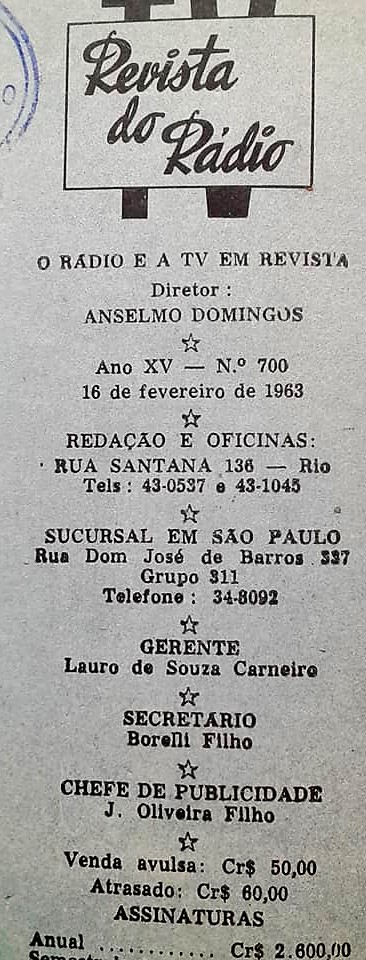
Multi-media performer Celia Vilela, who's been a singer, dancer, show-girl, radio announcer, TV Master of Ceremonies and a journalist working for weekly magazine 'Revista do Radio' meets Neil Sedaka at the Copacabana Palace's swimming pool grounds on his 3rd trip to Brazil. 

Neil says this time he came up to Rio de Janeiro to have a special appearance in 'Instant love' (Pão de Açucar), a Hollywood production set in the 'Wonderful City' (Cidade Maravilhosa) starring Rossano Brazzi, Rhonda Fleming & Odete Lara.

Sedaka tells the journalist he was the first American artist to sing Brazilian Bossa Nova in the USA. Telling about his beginnings he says the first time he went on the stage was as a pianist and he confesses he was really nervous.

Why did you become a singer? I followed the advice of people like Ray Charles, Connie Francis and Bobby Darin to whom I had to show some of my songs when I was barely 16 years old.

'Revista do Radio' n.700 - 10 February 1963 - says Neil Sedaka is 'controlled' by his Mother.

As Neil talked to the journalist he kept on looking at his mother as if he expected her  approval.

We asked him what is Brazil's best singer and he said he considered João Gilberto the top. As the reporter saw Celia Vilela following the chat he said he'd thought Sedaka would have chosen Vilela.

Sedaka wasn't abashed. He said: 'I like Celia Vilela as a singer too. Besides she's my best friend in this country. Just to prove it, Mother and I went to have dinner at Celia's apartment only last night'. 

Why did you bring your Mother along this time? 'Because I like to travel with Mom! We have just traveled through Italy recently. Mother is a sharp businesswoman. I feel really secure in her hands'. 

Then, your Mother is your agent? - 'I have both an agent and a publicity man who follow me around  but Mother's last word is what it counts to me'.  

Neil Sedaka, his mother Eleanor Appel Sedaka & Celia Vilela at the Copacabana Palace. 

Monday, 14 May 2018

1 9 5 7 - rock'n'roll gets started in Brazil

It is common knowledge that Rock'n'roll aka the Rock Era has started in the USA when the single (We're gonna) 'Rock around the clock' recorded by Bill Haley & His Comets reached Number One in the singles-charts on 14 May 1955

And when Elvis Presley reached Number One on the pop charts on 10 March 1956, with 'Heartbreak Hotel', rock'n'roll music found a leader for millions of devoted teenagers worldwide.
19 December 1956 - The Wednesday 'Rock around the clock' (Ao balanço das horas) opened in São Paulo. 

Brazilians who always took a hint from the 'Metropolis', read about the emergence of a new 'craze' called rock'n'roll in local newspaper & magazine but it took a while until Rock started showing up in Rio de Janeiro or Sao Paulo its two biggest cities.
3rd February 1957 - OESP night-life columnist Mary Wynne announces the first rock'n'roll show in Brazil that would happen on the same week as the film 'Rock around the clock' premiered in São Paulo. A certain Ciro B. e seus Crazy Boys would show their prowess in dancing the new rhythm at Salão de Festa do Molinaro, on Rua Rego Freitas, 470. Ciro B. & the Crazy Boys would be accompanied by Ernani and his Combo, that usually played at Boite Caprice on the same Rua Rego Freitas, 547.
7 February 1957 - Mary Wynne gives more information about Boite Caprice and their owner Rubens Faria and Ernani, the latter was instrumental in putting on the first rock'n'roll event in the city.  

I would say the rock'n'roll started showing its first signs in Brazil around 1957. Here are some newspaper clips about rock or movies related to the 'ritmo alucinante'.
17 February 1957 - American night-life columnist Mary Wynne writes at daily 'O Estado de S.Paulo' two notes about two different events occurred in São Paulo night-clubs related to the rock'n'roll craze:

At Bar Michel, US pianist Fred Feld is a great sensation when he sings 'like Elvis Presley'.

At Boite Oasis, instrumentalist-crooner William Fourneau entertained a rowdy young crowd performing rock'n'roll numbers helped by Elza Aguiar and João de Lima & his combo.

E não faltam as turmas de 'stay-out-night' que passam pela Boite Oasis. Ultimamente está ganhando ainda mais frequentadores entre os 'fans' do 'Rock and roll', que está pegando com todos os 'habituées' do Oasis, alguns dançando enquanto outros apreciam e marcam tempo batendo palmas. Está vendo a alegria do 'Rock and roll', dirigido pelo William Fourneaud, Elza Aguiar e o conjunto de João de Lima.
24 February 1957 - Rock's first film ever. It was released in the USA on 7 December 1956, barely 2 months before arriving in Sao Paulo which was like being released simultaneously... that showed how much the rock'n'roll craze was being eagerly folllowed by the South American youth. 'Rock, rock, rock' (Ritmo alucinante) starred Tuesday Weld & Teddy Randazzo and featured Chuck Berry ('You can't catch me'), Frankie Lymon & the Teenagers ('I'm not a juvenile delinquent'), The Flamingos, Connie Francis etc.
24 March 1957 - Playwright & humorist Silveira Sampaio wrote a revue 'Vovó, papai & rock'n'roll' (Granddad, father & rock'n'roll)... that proves that the word 'rock'n'roll' was already embedded in the Portuguese language by March 1957.
Kids went crazy about Elvis at the premiere of 'Love me tender' at the Paramount Theater in Manhattan on 15 November 1956.
in New York City's Times Square.
downtown Los Angeles...
7 April 1957 - Rock'n'roll sensation Elvis Presley has his 1st movie 'Love me tender' (Ama-me com ternura) released in Brazil less than 6 months after its premiere at the Paramount Theater in New York on 15 November 1956.
12 May 1957 - Barely 6 months after its release in the USA 'The girl can't help it' reached Brazilian shores as 'Sabes o que quero' (You know what I want). The movie was originally intended as a vehicle for American sex symbol Jayne Mansfield, with a satirical subplot involving teenagers and rock'n'roll music. The unintended result has been called the 'most potent' celebration of rock music ever captured on film. Gene Vincent sings his fundamental 'Be-bop-a-lula'; Julie London performs her red-hot 'Cry me a river'; Eddie Cochrane does '20-flight rock' (Albert Pavão covered it as 'Vigésimo andar') but Little Richard is the greatest of all the rock acts.
25 August 1957 - Even though 'Cha cha boom!' (A música proibida) (1956) is not exactly a rock-movie it was made in response to the whole craze about 'new' rhythms like the cha-cha, mambo. Done by the same company that did 'Rock around the clock' it stars Latin American band-leader Damaso Perez Prado...
Latin American rhythms in the American Way... Mambo King Perez Prado is the one on the right...
20 October 1957 - Before 1957 was through, another dance-craze movie is released: 'Calypso heat wave' (Ao compasso do calypso) produced by the same crowd who did 'Rock around the clock' and 'Cha-cha boom!'. See the well-behaved Hi-Lo's and The Tarriers trying their emulate Harry Belafonte in 'Banana boat song'.
1st June 1958 - a milder version of rock'n'roll was personified by Pat Boone! He had a good voice, a goody-too-shoes appearance and could swing & rock just a little. Even though he covered Black rhythm'n'blues for Dot Records his most successful singles were ballads like 'April love' - that became the movie 'Primavera do amor' - or his cover of Gene Austin's 1931 hit 'Love letters in the sand'.